

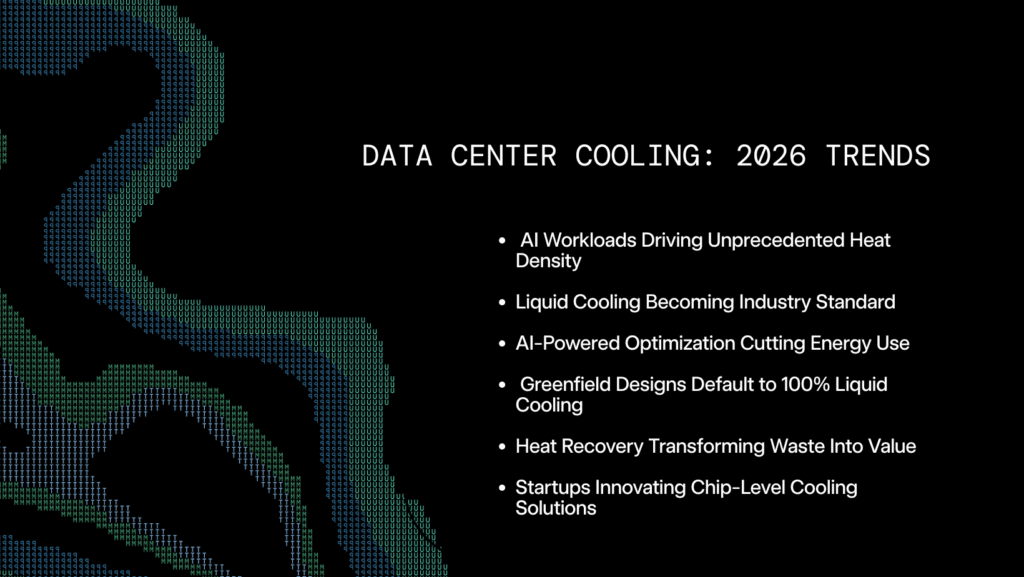
As AI workloads push rack densities beyond 100 kilowatts, the data center industry faces a thermal crisis that air conditioning simply cannot solve. The future of data center cooling is no longer about incremental improvements–it’s a fundamental shift from air to liquid, from reactive maintenance to AI-driven optimization, and from energy waste to heat recovery.
According to Mordor Intelligence, the global data center cooling market reached $12.41 billion in 2026 and is projected to surge to $28.5 billion by 2032. The question facing operators today is no longer whether to adopt advanced data center cooling technologies, but how to deploy them fast enough to keep pace with AI infrastructure demands.In this article, we’ll explore the emerging data center cooling solutions reshaping the industry—from direct-to-chip and immersion cooling to AI-driven optimization and the critical choices between greenfield and retrofit deployment strategies.
Data cooling challenges – The AI Heat Crisis
Traditional air-cooled racks handle 10-15 kW of power density. Today’s NVIDIA H100-based AI clusters demand 40-60 kW per rack, with next-generation systems pushing toward 120-240 kW. Water and specialized coolants carry roughly 3,000 times the heat capacity of air, making liquid-based data center cooling solutions the only viable path forward.
By 2024, liquid cooling had captured 46% of the market, according to industry analysts. The International Energy Agency projects global data center power consumption could reach 1,050 TWh by 2026–largely driven by AI workloads and GPU deployments.
Direct-to-Chip Cooling: Precision at the Source
Direct-to-chip (D2C) cooling has emerged as the most widely adopted liquid cooling method, with cold plates mounted directly onto processors to extract heat at the source. Modern systems remove 70-80% of heat loads directly from chips, dramatically reducing facility-level infrastructure demands.
Leading infrastructure providers have partnered with GPU manufacturers on reference designs for operators upgrading existing facilities without complete overhauls. Production systems now capture up to 98% of system heat while enabling quieter operation, and advanced solutions cool 4,500W per GPU socket using warm facility water–eliminating expensive chilled water requirements.
Immersion Data Cooling: The High-Density Frontier
For extreme power densities, immersion cooling submerges entire servers in non-conductive dielectric fluid. Data center cooling companies have deployed production-scale solutions achieving PUE scores below 1.03–compared to 1.4-1.6 for air-cooled facilities.
According to industry research from Mordor Intelligence, the immersion market is projected to grow from $4.87 billion in 2025 to $11.10 billion by 2030. Europe leads adoption, driven by sustainability regulations. However, comprehensive installations can cost $50,000+ per rack, making greenfield builds more economical than retrofits for many operators.
Embedded Data Cooling & AI Innovation
The future of data center cooling technologies extends to chip-level integration. TSMC’s Direct-to-Silicon Liquid Cooling and similar embedded microchannels demonstrate three-times-higher heat-removal efficiency while reducing chip temperatures by over 80%. Recent trials with bio-inspired microfluidic designs–featuring channels as narrow as 70 micrometers–show how next-generation solutions can cool dies dissipating 2 kW of power using just 10W of pump power.
Meanwhile, AI-powered optimization is transforming operations. Recent industry deployments of AI-driven cooling control systems are achieving up to 30% energy savings through real-time predictive adjustments. Multi-agent AI systems demonstrate 14-21% efficiency gains by coordinating temperature, carbon emissions, and costs across entire facilities.
Greenfield vs. Retrofit: Deployment Strategies
Purpose-built AI facilities increasingly incorporate 100% liquid cooling from the ground up. Recent supercomputer deployments–including 100,000+ GPU clusters in converted industrial facilities–prove massive liquid-cooled systems can be built in existing buildings, dramatically reducing time-to-production.
For legacy facilities, modular solutions bridge the gap. Prefabricated, liquid-cooled data center pods now arrive factory-sealed and deploy in weeks. The complexity of choosing between retrofit and greenfield approaches–and determining which liquid cooling technologies suit each scenario–has become a focal point for the industry.
These deployment questions will be explored in depth at Compute Summit 2026 (March 10-11, Barcelona), where dedicated sessions on scaling liquid and immersion cooling will address practical implementation challenges across different facility types. Decision-makers from companies actively deploying these solutions–including Equinix, NVIDIA, Google, Microsoft, AWS, Schneider Electric, Dell Technologies, and data center operators like Global Switch and VIRTUS Data Centres–will share insights alongside infrastructure investors from firms such as KKR, I Squared Capital, and Ardian.
The Road Ahead
Despite rapid progress, challenges remain: high upfront costs, retrofit complexity, skills gaps, and supply chain constraints. Addressing these barriers requires collaboration between operators, infrastructure providers, and innovators to develop more accessible and cost-effective data center cooling solutions.
Startups play a critical role in this transformation, developing breakthrough approaches that challenge conventional thinking. From microfluidic chip-level cooling to AI-driven thermal management platforms, emerging data center cooling companies are finding ways to reduce costs, improve efficiency, and accelerate deployment timelines. Recognizing this importance, industry events like Compute Summit 2026 have created dedicated platforms–including the Compute Challengers pitch competition with a specific Cooling & Thermal Systems track–to spotlight innovations that could reshape the market.
The industry continues to evolve through knowledge sharing and cross-sector partnerships–combining technical innovation, operational expertise, and strategic investment to transform cooling from infrastructure bottleneck into competitive advantage. For those looking to engage with these developments firsthand, tickets for Compute Summit 2026 are now available.
Q&A
Q1. Why can’t air cooling handle modern AI workloads?
Air cooling becomes inefficient above 10-15 kW per rack. Modern AI systems demand 40-120 kW or more, requiring liquid-based data center cooling technologies with 3,000 times the heat capacity of air.
Q2. What are the main types of data center cooling solutions?
The primary data center cooling solutions include direct-to-chip cooling, immersion cooling, rear-door heat exchangers, and emerging embedded cooling with microchannels within silicon.
Q3. How do data center cooling companies address retrofit challenges?
Leading data center cooling companies offer modular solutions, prefabricated pods, and hybrid systems that layer liquid cooling onto existing air infrastructure without complete facility overhauls.
Q4. What is the future of data center cooling?
The future of data center cooling combines liquid cooling adoption, AI-driven optimization, waste heat recovery, and embedded chip-level cooling. Market growth from $10.8B in 2025 to $28.5B by 2032 reflects this transformation.
Q6. What will be covered at Compute Summit 2026 regarding cooling technologies?
Compute Summit 2026 (March 10-11, Barcelona) features dedicated sessions on scaling liquid and immersion cooling for both greenfield and retrofit environments. The summit includes the Compute Challengers pitch competition with a Cooling & Thermal Systems track, where startups showcase breakthrough innovations. Industry leaders from companies like Equinix, NVIDIA, Google, Microsoft, and AWS will share practical deployment strategies and real-world lessons.